Luxury Spanish Tile USA: The 2026 Definitive Authority Guide
Luxury spanish tile usa the architectural silhouette of the American Sun Belt is inextricably linked to the undulating geometry of kiln-fired earth. From the sprawling estates of Montecito to the historic districts of Coral Gables, the presence of barrel-vaulted clay serves as both a cultural marker and a high-performance thermal shield. In the contemporary market, “Spanish tile” has evolved from a generic descriptor into a specialized category of building science, where the distinction between mass-produced concrete and artisanal clay defines the longevity and prestige of the structure.
Selecting a roofing system in this tier is an exercise in balancing geological permanence with structural engineering. The weight of these systems—often exceeding 800 to 1,200 pounds per square—demands a level of architectural forethought that petroleum-based alternatives simply do not require. To invest in this medium is to commit to a century-long lifecycle, necessitating a shift in perspective from mere “shelter” to the stewardship of a legacy asset. In the United States, where weather patterns are increasingly characterized by extreme thermal swings and high-velocity wind events, the inherent mass and non-combustibility of tile provide a level of resilience that few other materials can replicate.
However, the path to a successful installation is fraught with technical nuances. The industry is currently seeing a divide between traditional “two-piece” Mission styles and modern “S-tile” interlocking systems, each offering distinct advantages in terms of water management and aesthetic depth. Furthermore, the emergence of high-emissivity glazes and specialized underlayments has transformed the Spanish tile roof from a passive historical element into an active component of a home’s energy-efficiency strategy. This article examines the systemic realities, economic variables, and artisanal standards that govern the highest tier of the industry.
Understanding “luxury spanish tile usa”
To master the nuances of luxury spanish tile usa, one must first distinguish between material composition and geometric form. The term “Spanish tile” frequently serves as a catch-all for any S-shaped or barrel-shaped profile. In the luxury sector, however, the emphasis is placed on “high-fire” clay—tiles fired at temperatures exceeding 2,000°F. This process vitrifies the clay, rendering it nearly impervious to water absorption and resistant to the “spalling” or surface flaking that often plagues lower-tier concrete imitations.
A common misunderstanding involves the “interlocking” mechanism versus the “traditional overlap.” Interlocking tiles, while more modern and often easier to install, can sometimes lack the deep shadow lines and irregular textures that define an authentic Mediterranean aesthetic. The luxury market often favors “two-piece Mission” tiles—separate pan and cover units—which allow for a more customizable “staggered” appearance. This traditional method, while more labor-intensive, provides a superior aesthetic depth that reflects the artisanal heritage of the form.
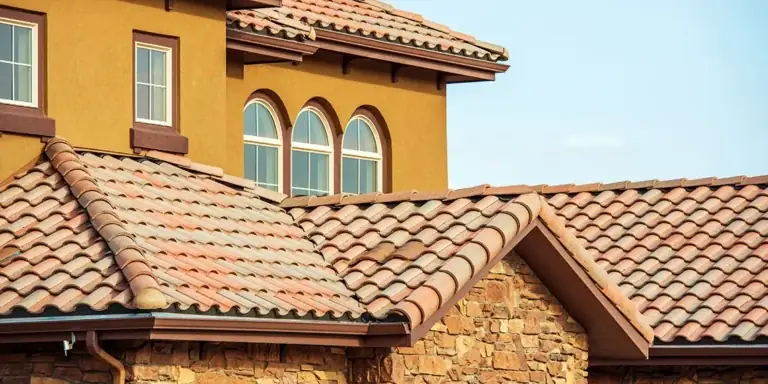
The oversimplification of color is another risk. While “terracotta” is the baseline, luxury installations utilize “flashed” or “multi-colored” palettes where no two tiles are identical. This creates a “movement” across the roofline that mimics the natural weathering seen in historic Spanish and Italian villas. Without this variegation, a tile roof can appear flat and artificial, diminishing the architectural gravity of the home.
The Historical Evolution of Mediterranean Roofing in America
Luxury spanish tile usa the presence of clay tile in the United States is a legacy of the Spanish Colonial period, particularly in Florida and the Southwest. Originally, tiles were formed by hand over the thighs of artisans, resulting in the characteristic taper of the “Mission” style. These early roofs were heavy, inefficient at shedding water by modern standards, and required constant maintenance. Yet, they were perfectly adapted to the local climate, providing a “thermal lag” that kept interiors cool during the peak of the day.
The “Spanish Colonial Revival” of the early 20th century—driven by architects like George Washington Smith and Bertram Goodhue—elevated the material to its current status as a luxury staple. During this era, the development of industrial kilns allowed for more consistent quality, but the aesthetic remained rooted in the irregular, hand-crafted look of the past. Today, the evolution continues through the integration of robotic precision in firing and the development of “cool-roof” glazes that reflect infrared light without sacrificing the classic matte finish of traditional terracotta.
Conceptual Frameworks for High-Mass Roofing Luxury Spanish Tile Usa
To effectively plan and maintain a luxury tile system, three mental models are essential:
1. The Thermal Mass Buffer
This framework treats the roof as a “heat battery.” Clay tiles absorb solar radiation throughout the day, but because of their density, the heat takes hours to migrate through the material to the roof deck. By the time the heat reaches the interior, the sun has set, and the cool night air begins to pull that heat back out. This “lag effect” is a cornerstone of Mediterranean passive cooling.
2. The Hydrostatic Pressure Model
Unlike asphalt shingles, which rely on a continuous “sticky” seal, tile roofs are “water-shedding” systems. They utilize gravity and overlaps. In the luxury tier, the “path of the drop” must be managed not just on the tile surface, but on the underlayment. This framework views the tiles as the “decorative armor” and the underlayment as the “waterproof skin.”
3. The Structural Loading Horizon
Because clay is permanent, the “governance” of the roof must match its lifespan. It is illogical to install a 100-year tile over a 20-year felt underlayment or with copper nails that will corrode. This model dictates that every secondary component—flashings, fasteners, and battens—must have a service life that matches the clay itself.
Core Categories and Species of Spanish Tile
| Category | Material | Aesthetic Profile | Primary Advantage |
| Two-Piece Mission | High-Fire Clay | Deep shadow lines; irregular | Maximum authenticity; high airflow |
| Interlocking S-Tile | High-Fire Clay | Clean, repeating waves | Efficient installation; lighter weight |
| Concrete Spanish | Pigmented Cement | Uniform; varied colors | Cost-effective; high impact resistance |
| Glazed Artisanal | Ceramic Coated Clay | High-gloss or satin finishes | Impervious to salt spray; unique colors |
| Sand-Faced Clay | Clay with Grit Finish | Weathered, rustic texture | Mimics ancient reclaimed tiles |
| Synthetic Composite | Polymer / Rubber | Uniform; lightweight | Suitable for structures with low load limits |
Realistic Decision Logic
The choice between clay and concrete is often dictated by the “freeze-thaw” cycle. In regions like the Coastal Carolinas or Florida, clay is superior for its salt-air resistance. In high-altitude or inland areas where temperatures fluctuate rapidly across the freezing point, a “Grade 1” clay tile (the highest rating for frost resistance) is mandatory. Concrete, while durable, is more porous and can absorb moisture that expands when frozen, leading to internal fractures over time.
Detailed Real-World Scenarios Luxury Spanish Tile Usa
Scenario A: The Oceanfront Estate (Palm Beach, FL)
-
The Constraint: Constant salt-air exposure and Hurricane Zone 4 wind speeds.
-
The Solution: Two-piece glazed Mission tiles, “triple-nailed” with 316-grade stainless steel screws and high-wind foam adhesive.
-
The Outcome: The glaze prevents salt from pitting the clay surface, while the mechanical and adhesive “dual-fastening” system ensures the tiles remain a cohesive shield during 150 mph gusts.
Scenario B: The Desert Modern (Scottsdale, AZ)
-
The Constraint: Intense UV radiation and high “Diurnal Temperature Swing.”
-
The Solution: Unshaded, high-emissivity terracotta S-tile with a “vented batten” system.
-
The Outcome: The vented battens allow air to move underneath the tiles, carrying away trapped heat before it can penetrate the attic, reducing cooling costs by up to 20%.
Planning, Cost, and Resource Dynamics
The economic profile of luxury spanish tile usa is defined by the “Labor-to-Material Ratio.” On a typical asphalt roof, labor is roughly 60%. On a luxury tile roof, labor can account for 75% of the total cost due to the precision required in “miter-cutting” valleys and the structural reinforcement of the eaves.
| Investment Tier | Material Cost (Per Sq) | Total Installed Cost (Average 3,000 sq ft roof) | Expected Lifespan |
| Premium Concrete | $300 – $500 | $35,000 – $55,000 | 30 – 50 Years |
| Standard Clay S-Tile | $600 – $900 | $55,000 – $85,000 | 75+ Years |
| Bespoke Two-Piece Clay | $1,200 – $2,500 | $110,000 – $250,000+ | 100+ Years |
The Opportunity Cost of Weight Luxury Spanish Tile Usa
One must factor in the “Structural Tax.” If a home was not originally designed for tile, adding a luxury clay system may require $10,000 to $30,000 in additional structural beams and rafters. Failure to account for this can lead to “settling” issues, where doors and windows no longer align properly under the new load.
Tools, Strategies, and Support Systems
-
Elevated Battens: Creating a 1/2-inch air gap between the tile and the deck to facilitate “Above Sheathing Ventilation” (ASV).
-
Copper Flashings: Using 16-oz or 20-oz copper for valleys and chimneys, which develops a patina that complements clay.
-
High-Temp Self-Adhered Underlayment: Standard underlayments can “cook” under hot tile; a high-temp (rated to 260°F) membrane is essential for luxury builds.
-
Bird Stops (Eave Closures): Specialized metal or clay inserts that prevent nesting in the barrel of the tile, which can cause debris buildup and fire risks.
-
Tile Adhesive Foam: A two-component polyurethane foam used in addition to nails to increase wind uplift resistance in coastal zones.
-
Storm Clips: Individual stainless steel clips that hook the nose of the tile to the batten, preventing “chatter” during high winds.
Risk Landscape and Failure Modes Luxury Spanish Tile Usa
The primary risk in the Spanish tile sector is “Underlayment Prematurity.” If a homeowner installs a 100-year tile over a 20-year underlayment, they will eventually face a “lift and relay” project—an expensive operation where every tile must be removed, the skin replaced, and the tiles reinstalled.
The Failure Taxonomy:
-
Mechanical Failure: Tiles “walking” or sliding down the roof because they were only hung by lugs without mechanical fasteners.
-
The “Gutter Trap”: Tiles extending too far into the gutter, preventing proper cleaning and causing water to “wick” back up into the fascia.
-
Vapor Entrapment: In tightly sealed modern homes, a lack of ventilation under the tile can trap moisture, leading to rot in the plywood deck that is invisible from both the attic and the roof surface.
Governance, Maintenance, and Long-Term Adaptation
A luxury tile roof requires a “Stewardship Protocol” that occurs on a multi-year cycle:
-
Annual Debris Sweep: Specifically in the valleys and “dead-wall” intersections. Organic matter (leaves, needles) acts as a sponge, holding moisture against the underlayment and causing premature degradation.
-
The 5-Year Fastener Audit: Checking for “popped” nails or backing-out screws, especially on the ridge and hip caps where wind vibration is highest.
-
Efflorescence Monitoring: Identifying the white, chalky salt deposits that can appear on new tiles. While usually cosmetic, persistent efflorescence can signal a drainage issue where water is lingering on the tiles too long.
Measurement, Tracking, and Evaluation Luxury Spanish Tile Usa
Evaluation of success is found in the “Temperature Differential.” A successful luxury spanish tile usa installation should show a significantly lower attic temperature during peak summer hours compared to an asphalt-roofed neighbor.
-
Leading Indicator: The integrity of the bird-stops and eave closures.
-
Lagging Indicator: Any “damp spots” on the underside of the roof deck in the attic, which indicate a breached tile and a failed underlayment.
-
Documentation Example: A “Fastener Map” provided by the contractor, showing the specific screw pattern used to satisfy wind-code requirements for insurance purposes.
Common Misconceptions and Oversimplifications
-
“Tile roofs are maintenance-free.” No roof is maintenance-free. Tiles are permanent, but the assembly (valleys, penetrations, underlayment) requires oversight.
-
“Clay tile is too heavy for my house.” Most modern homes can be retrofitted with lightweight clay tiles or have their structure reinforced to handle the weight.
-
“Walking on the roof will break all the tiles.” While you should avoid walking on them, a “High-Fire” Grade 1 clay tile is remarkably strong. Professionals use walk-pads or distribute their weight to prevent cracking.
-
“Concrete is just as good as clay.” For the first 10 years, perhaps. After 30 years, concrete will lose its pigment and show surface erosion, whereas clay will look virtually the same for a century.
-
“The red color is paint.” In luxury clay, the color is the result of the natural minerals in the earth and the firing temperature. It is “through-body” color that cannot fade.
-
“Solar panels can’t be installed on tile.” They can, but they require specialized “tile hooks” that bypass the tile to attach directly to the rafters, ensuring the tile’s integrity isn’t compromised.
Conclusion
The architecture of the American Mediterranean is a commitment to the long view. Investing in luxury spanish tile usa is a rejection of the disposable culture of modern building, opting instead for a material that has survived empires. When executed with the proper underlayment, elevated battens, and artisanal attention to detail, a tile roof becomes more than a component; it becomes the defining characteristic of a home’s soul. It is a material that rewards patience, respects tradition, and—above all—understands the profound value of geological permanence in an era of rapid change.